Reflections from an IELTS tutor who has seen both worlds
I have coached IELTS candidates across living rooms in Lagos, virtual classrooms spanning time zones, and quiet late-night sessions with professionals preparing for migration or postgraduate study. Over the years, one question follows me everywhere:
“Can I pass by studying on my own, or do I need a coach?”
The honest answer is not as simple as choosing one side. Language learning behaves less like a straight road and more like a river — sometimes you swim strongly alone, and sometimes you need a pilot who knows where the hidden currents flow.
Let me walk you through what experience, educational research, and the realities of the Nigerian context reveal.
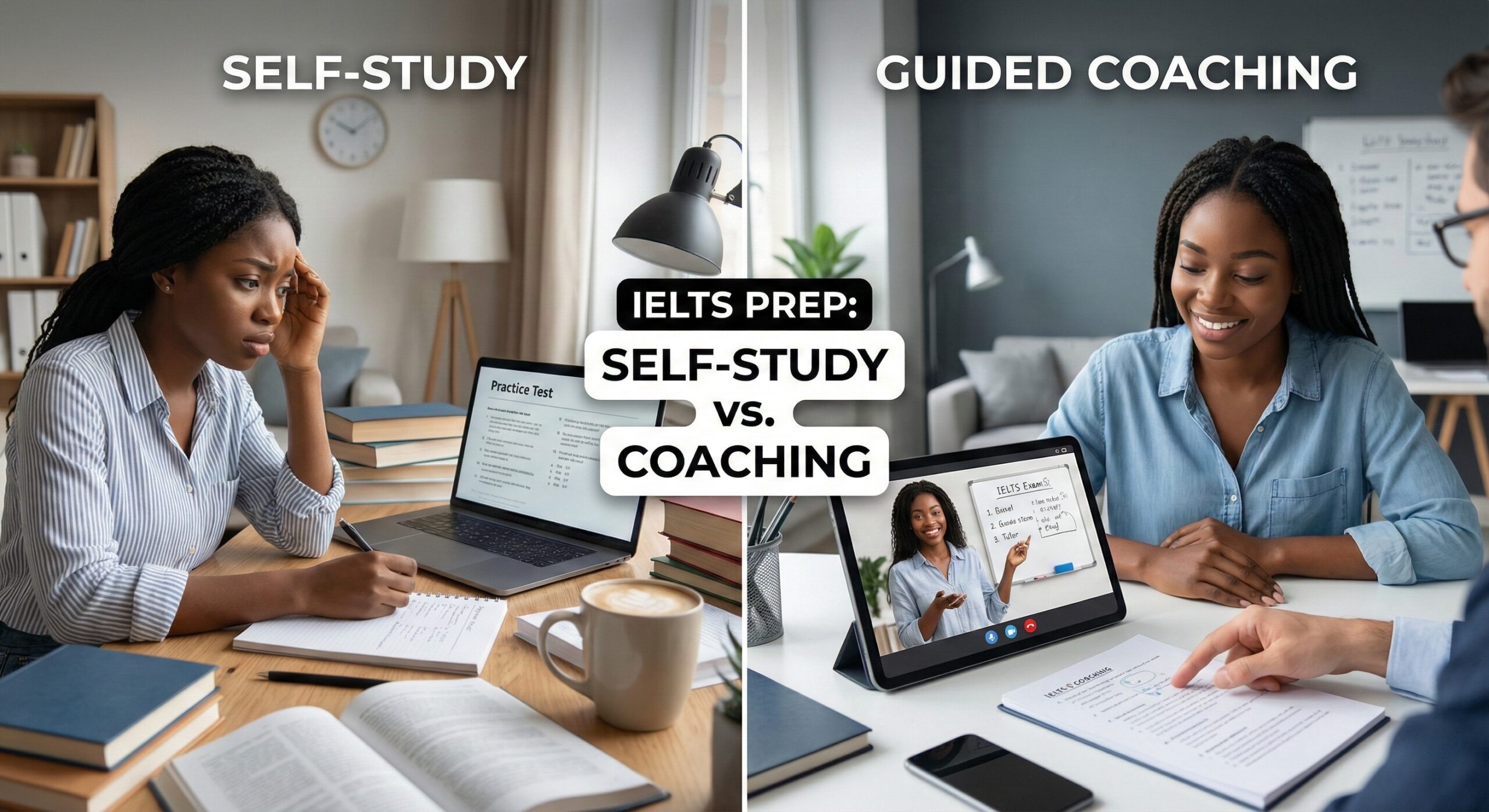
THE APPEAL OF SELF-STUDY: FREEDOM, FLEXIBILITY, AND OWNERSHIP
Many candidates in Nigeria begin their IELTS journey with self-study, and for good reasons. You control your schedule. You decide when to study, how long, and what to focus on. Official preparation platforms now provide free videos, webinars, apps, and practice materials, making independent preparation more accessible than ever.
From my experience, self-study works particularly well for learners who:
- Already use English frequently in professional or academic settings
- Have strong self-discipline and study habits
- Can evaluate their own mistakes realistically
- Are targeting moderate band scores rather than dramatic jumps
Online communities often share stories of candidates who scored high bands using mostly official mock tests and structured practice. What these stories quietly reveal, though, is that many of these learners already had a strong language foundation before beginning prep.
THE HIDDEN CHALLENGES
Here is where self-study often begins to wobble. Research consistently shows that motivation and self-efficacy strongly influence language learning outcomes. When confidence drops, progress slows.
In practice, I see three common problems:
- No feedback loop: Writing and speaking errors become invisible to the learner.
- Inconsistent routines: Busy schedules easily interrupt momentum.
- Exam misunderstanding: Students practise English generally but not the specific IELTS criteria.
Self-study can feel empowering — until a candidate repeats the same mistake across five mock tests without realizing it.
GUIDED COACHING: STRUCTURE AS A COMPASS
Guided coaching introduces something self-study often lacks: external perspective. A coach does more than teach grammar or vocabulary. The real value lies in diagnosis — identifying why a candidate’s score stagnates.
In my own sessions, coaching tends to transform three areas:
1. Clarity
Many candidates believe they are weak in English when their real issue is strategy — timing, task response, or coherence.
2. Precision
A coach narrows focus. Instead of reading twenty resources, students work on the two habits that move the score.
3. Accountability
When someone expects your essay every Thursday, procrastination becomes harder.
THE NIGERIAN CONTEXT: WHY THE CHOICE FEELS DIFFERENT HERE
Preparing for language proficiency exams in Nigeria comes with unique realities:
- Internet instability and inconsistent power supply can disrupt independent routines.
- Many students juggle work, family, and economic pressures.
- There is sometimes misinformation from unofficial prep centres promising “secret answers.”
I have seen candidates spend months doing random YouTube lessons without measurable improvement — not because they lacked intelligence, but because they lacked direction.
WHO SHOULD CHOOSE SELF-STUDY?
Self-study may be enough if:
- Your current level is already close to your target band.
- You have strong time management.
- You can critically assess your writing and speaking.
- You thrive in independent learning environments.
WHO NEEDS GUIDED COACHING?
Coaching becomes highly valuable when:
- You have taken the exam before without improvement.
- Writing or speaking scores lag behind other modules.
- You need a specific band for migration or admission within a deadline.
- You struggle with consistency or confidence.
THE MODEL I RECOMMEND MOST: THE LAYERED APPROACH
After years of watching candidates succeed and struggle, my most honest recommendation is a hybrid system:
- Begin with guided coaching or a diagnostic assessment.
- Build a personalised study plan.
- Execute most practice independently.
- Return for targeted feedback and mock evaluation.
This model respects both your wallet and your time while keeping your preparation evidence-based.
FINAL REFLECTION
I often tell my students that IELTS is not merely an exam; it is a snapshot of how effectively you communicate under pressure. Self-study builds independence. Coaching sharpens direction.
The best results I have witnessed came from candidates who learned to do both — learners who became their own coaches while still accepting guidance when the road blurred.
“What kind of learner am I today — and what support will move me forward fastest?”
Sometimes the strongest progress begins when we stop choosing sides and start building systems.